You have a website.
People visit it.
But hardly anyone contacts you.
Sound familiar?
Getting website traffic is only one part of digital marketing. The real challenge is converting visitors into leads and customers.
A website can look beautiful and still perform poorly if it doesn’t clearly communicate its value or make it easy for visitors to take action.
Here are some of the most common reasons a website isn’t generating leads.
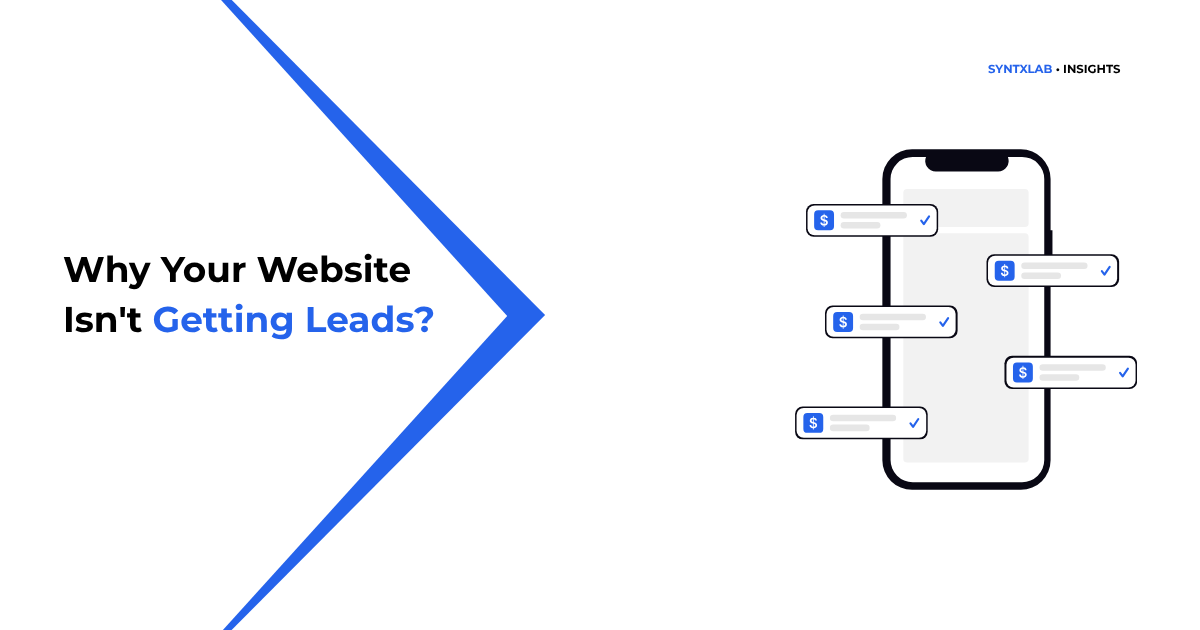
1. Your Website Doesn’t Clearly Explain What You Do
When someone lands on your homepage, they shouldn’t have to investigate to understand your business.
Your headline should communicate:
What you do + who you help + the value you provide.
For example, instead of:
“Welcome to Our Digital World.”
consider something more specific:
“Performance Marketing for Growing Businesses.”
Clarity beats cleverness.
2. There Is No Clear Call to Action
Visitors need direction.
If your website contains information but doesn’t tell people what to do next, many will simply leave.
Useful calls to action include:
- Get a Free Consultation
- Request a Quote
- Book a Call
- Start Your Project
- Contact Us
- Get a Strategy Call
Your CTA should match the customer’s stage in the buying journey.
3. You’re Talking Only About Yourself
Another common mistake is making the website entirely about the company.
“We have been operating since…”
“Our team…”
“Our mission…”
These things matter, but customers primarily want to know:
How can you solve my problem?
Shift the focus toward customer outcomes.
Instead of saying:
“We provide SEO services.”
You could explain:
“We help businesses increase qualified organic traffic and generate more search-driven leads.”
4. There Isn’t Enough Trust
A visitor may like your service but still hesitate to contact you.
Why?
Because trust is missing.
Consider adding:
- Testimonials
- Client logos
- Reviews
- Case studies
- Results
- Certifications
- Portfolio examples
- Team information
Don’t invent results or testimonials. Real proof is far more valuable than exaggerated claims.
5. Your Website Is Too Slow
A slow website creates friction.
People expect websites to load quickly, especially on mobile devices.
Large images, unnecessary scripts, poor hosting, and excessive animations can all contribute to performance problems.
Website performance should therefore be treated as part of marketing—not just a technical issue.
6. Your Website Isn’t Mobile-Friendly
A huge portion of online activity happens through smartphones.
If your website looks great on a desktop but is difficult to navigate on mobile, you are potentially losing customers.
Check:
- Font sizes
- Button sizes
- Navigation
- Image scaling
- Forms
- Page speed
- Horizontal scrolling
Your mobile experience should not feel like an afterthought.
7. Your Landing Page Has Too Many Distractions
A landing page should have one primary objective.
If a page has:
10 buttons,
15 menu links,
multiple unrelated offers,
huge blocks of text,
and several competing CTAs,
the visitor may not know what to do.
Reduce distractions and focus the page around one clear action.
8. You’re Getting the Wrong Traffic
Sometimes the website isn’t actually the problem.
You may simply be attracting people who aren’t potential customers.
For example, ranking for an informational keyword can bring visitors who want to learn something but have no intention of purchasing.
Your marketing strategy should therefore focus not just on traffic volume, but on qualified traffic.
The Solution
Improving website lead generation usually requires looking at the entire customer journey.
Ask:
Where did the visitor come from?
What did they expect to find?
Did the page answer their question?
Did they trust the business?
Was the offer clear?
Was the CTA obvious?
Once you understand where visitors are dropping off, you can start improving the website systematically.
Your website isn’t supposed to simply look good. It should communicate, build trust, remove objections, and make taking the next step easy.